
The Art of Figure Drawing: Studying the Human Form
View available original works and prints at androskarr.art
The Enduring Tradition of Figure Drawing
Figure drawing is one of the oldest and most fundamental disciplines in fine art. For centuries it has been the foundation of an artist's training — the practice through which one learns to see proportion, structure, weight, and movement in the human body. From the anatomical studies of the Renaissance to the academic ateliers of the nineteenth century, drawing the human figure has remained the truest test of an artist's eye and hand. This article looks at figure drawing as a fine-art practice, and at the hand-drawn work of Houston artist Andros Karr.
Understanding the Human Form
At its core, figure drawing is about understanding anatomy — the proportions, the underlying structure, and the subtle relationships that make each body unique. It demands close observation: how light falls across a form, how weight distributes through a pose, how gesture conveys life. A successful figure drawing is not merely an accurate record; it captures presence — the sense that a living person occupies the page.
The Role of Light, Shadow, and Gesture
Much of a figure drawing's strength comes from the handling of light and shadow. Careful tonal work gives the form depth and dimension, lifting it off the flat surface of the paper. The positioning of the figure creates rhythm and movement, while attention to gesture and expression gives the drawing its emotional weight. These are the same principles that underpin classical drawing — observation, structure, and restraint.
Andros Karr's Approach
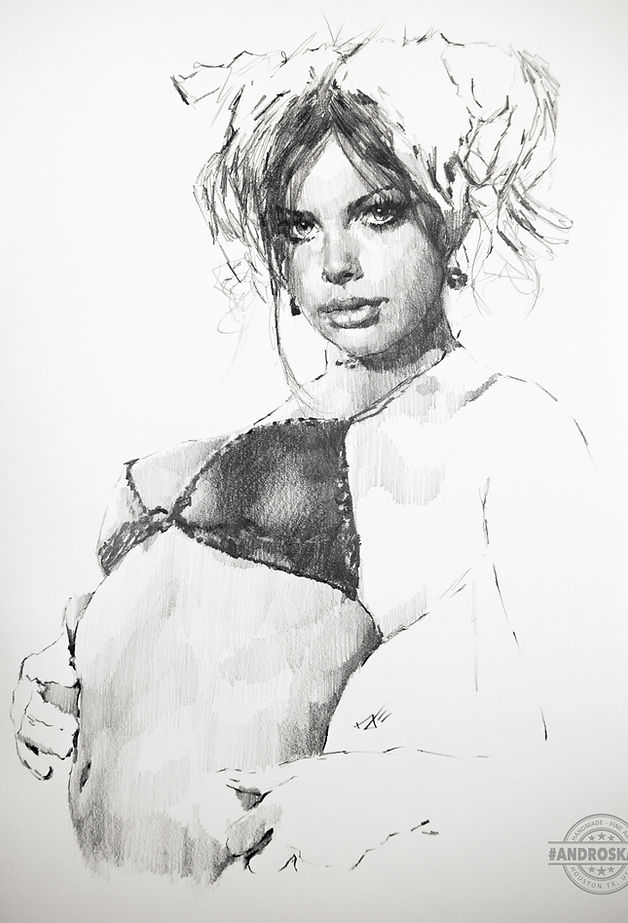
Andros Karr is a Houston-based artist working in graphite and charcoal, with a practice rooted in realistic figurative drawing. A former engineer, he brings a draftsman's discipline to the human form — an exacting attention to proportion, anatomy, and tonal structure. His figure studies are hand-executed on museum-grade cotton paper, each an original work, never a print, reproduction, or AI-generated image. The result is figurative drawing in the classical tradition: precise, considered, and made entirely by hand.
The Power of Graphite and Charcoal
Graphite and charcoal remain among the most expressive materials in figurative art. Graphite allows for fine control and subtle gradation; charcoal offers depth, richness, and a directness of mark. Together they let an artist render the human form with both precision and feeling — building intricate detail and broad tonal mass on the same sheet. In the hands of a skilled draftsman, these simple materials capture the structure and presence of the figure with remarkable life.
A Living Tradition
In an age of digital and AI-generated imagery, hand-drawn figurative work carries a particular value: it is singular, made by hand, and impossible to reproduce. Figure drawing connects the contemporary artist to a tradition stretching back centuries — the ongoing study of the human form as the central subject of art.
View available original works and prints at androskarr.art
